The Woven History Book: Baluchari: The Silk That Recorded History
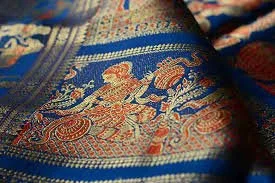
Part of the ArNe Heritage Series—exploring India’s endangered textiles one week at a time.
We usually learn history from textbooks. But this week, I learned that in Bengal, you can actually wear it.
I was fascinated to discover the Baluchari saree from Murshidabad. Unlike the floral or geometric motifs you see in most Indian textiles, the borders of a Baluchari look like comic strips from the 18th and 19th centuries.
The Backstory: Silk as a Recording Device The weavers of Murshidabad were the chroniclers of their time. They didn't just weave pretty shapes; they wove what they saw happening around them.
If you look closely at a vintage Baluchari, you don't just see patterns. You see social scenes: Nawabs holding court, European officers smoking hookahs, and women dancing. Later, when the British introduced technology, the weavers documented that too—you can find sarees depicting the arrival of the first steam trains in India.
They turned silk into a recording device.
My Personal Reflection As someone who loves data and documentation, the idea of a "textile document" blows my mind. It makes me wonder: what are our clothes saying about our time?
Fast fashion says we are in a hurry; we are disposable. But Baluchari says: "I was here. I saw this. And I took the time to weave it into memory." It is a reminder that fashion used to be a form of communication, not just consumption.
The Endangered Status The decline of this craft began long ago when a massive flood in the Ganges forced weavers to migrate, and colonial patronage vanished. Today, creating the complex Jacquard cards required to recreate these historical scenes is expensive, and the market for such heavy, narrative silk is niche.
Why We Must Save It Baluchari is a time capsule. If we let it disappear, we lose a unique record of Indian history that was written not in ink, but in silk.
What’s Next? Baluchari tells human stories. But next week, we travel to the valleys of Himachal, where the embroidery is dedicated to the divine—and the technique is so perfect, it has no reverse side.
Next Week: Endangered Thread #10—Chamba Rumal: Painting with a Needle.
Transparency Note
At ArNe Boutique, we believe in using modern tools to preserve ancient stories. This post was written with heart, researched by humans, and enhanced by AI to help us tell these stories more effectively. All facts, sentiments, and edits are 100% ours.